Lost your password? Please enter your email address. You will receive a link and will create a new password via email.
Please briefly explain why you feel this question should be reported.
Please briefly explain why you feel this answer should be reported.
Please briefly explain why you feel this user should be reported.
Amechieneer is a platform where the questions can be answered, doubts can be cleared, knowledge can be self tested through relevant quizzes, interviews can be cracked easily by having a glance on previous interview experiences in Mechanical Engineering. Enjoy the learning.

What is the purpose of garter spring in Lip seal?
Garter spring ensures a consistent radial force on the lip of a lip seal due to tension in the spring such that the gap formed between shaft and the lip of lip seal due to wear of lip or radial run out of shaft can be covered. Figure: Garter Spring in Lip seal
Garter spring ensures a consistent radial force on the lip of a lip seal due to tension in the spring such that the gap formed between shaft and the lip of lip seal due to wear of lip or radial run out of shaft can be covered.
Figure: Garter Spring in Lip seal
See lessIs a lip seal dynamic or static?
Lip seal is a dynamic seal since there is a relative motion between the mating surfaces. Generally, lip type seals are used to seal the radial gap between rotating shaft and stationary housing to prevent the leak of lubricants like oil or grease as well as it prevents the ingression of dirt or foreiRead more
Lip seal is a dynamic seal since there is a relative motion between the mating surfaces. Generally, lip type seals are used to seal the radial gap between rotating shaft and stationary housing to prevent the leak of lubricants like oil or grease as well as it prevents the ingression of dirt or foreign particles into the oil chamber.
Figure: Typical Lip Seal
See lessWhat is Pillow block bearing?
Pillow block is a type of bearing housing with included anti-friction bearings to support the shaft. Pillow block housing is classified further based on the type of bearing installed like spherical roller bearing, ball bearing. Etc. Figure: Typical Pillow Block Bearing
Pillow block is a type of bearing housing with included anti-friction bearings to support the shaft. Pillow block housing is classified further based on the type of bearing installed like spherical roller bearing, ball bearing. Etc.
Figure: Typical Pillow Block Bearing
See lessWhat is Plummer block bearing?
Plummer block is a type of bearing housing like pillow block, but the Plummer block is supplied without bearings. Anti-friction bearing of suitable choice can be used depending on the application.
Plummer block is a type of bearing housing like pillow block, but the Plummer block is supplied without bearings. Anti-friction bearing of suitable choice can be used depending on the application.
See lessWhat are the types of unbalances?
Unbalance in rigid rotating systems is classified into three types based on the relative position of the axis of rotation (i.e., shaft axis) and axis of centre of mass (i.e., center of gravity) of rotating rigid rotor. They are Figure 4: Figure represents the types of unbalances in rigid rotating syRead more
Unbalance in rigid rotating systems is classified into three types based on the relative position of the axis of rotation (i.e., shaft axis) and axis of centre of mass (i.e., center of gravity) of rotating rigid rotor. They are
Figure 4: Figure represents the types of unbalances in rigid rotating system
Follow the link for further reading: Balancing of Rigid Rotating Systems – The Mechanical Engineer (amechieneer.com)
See lessWhat is mechanical vibration?
In short, it is the vibration of rotating or reciprocating mechanical components. Every rotating and reciprocating component operating at certain speed generates vibration which is inevitable. Of course, we cannot see the high frequency vibrations visually, but we can feel it and measure it throughRead more
In short, it is the vibration of rotating or reciprocating mechanical components. Every rotating and reciprocating component operating at certain speed generates vibration which is inevitable. Of course, we cannot see the high frequency vibrations visually, but we can feel it and measure it through vibration sensors.
See lessHow to differentiate rotating element looseness and structural looseness from the vibration spectrum?
Rotating element looseness includes looseness in bearings, gears, couplings …etc and the vibration signal characteristic is as follows. Significant vibration amplitude in radial directions as compared to axial. Multiple harmonics from 1 $\times \,$ RPM to 10 $\times \,$ RPM.
Rotating element looseness includes looseness in bearings, gears, couplings …etc and the vibration signal characteristic is as follows.
- Significant vibration amplitude in radial directions as compared to axial.
- Multiple harmonics from 1

 RPM to 10
  RPM.
RPM.
See lessWhat is the source of mechanical looseness?
Mechanical looseness in the sense, improper contact between adjacent components. Mechanical looseness can occur due to following reasons. Improper tightening of bolts. Wear and tear of components Fracture in the component.
Mechanical looseness in the sense, improper contact between adjacent components. Mechanical looseness can occur due to following reasons.
- Improper tightening of bolts.
- Wear and tear of components
- Fracture in the component.
See lessWhat are the vibration characteristics of mechanical looseness?
The time period waveform is erratic and pattern is non repetitive. Frequency spectrum displays multiple harmonics 1 to 10 $\times \, $RPM, sub harmonics 0.5$\times \, $ RPM and half harmonic 1.5, 2.5, 3.5 $\times \,$ RPM. Some driving force is required for looseness. Mechanical looseness get aggraRead more
The time period waveform is erratic and pattern is non repetitive.
Frequency spectrum displays multiple harmonics 1 to 10
 RPM, sub harmonics 0.5
 RPM and half harmonic 1.5, 2.5, 3.5
  RPM.
RPM.
Some driving force is required for looseness. Mechanical looseness get aggravated in presence of driving force like unbalance…etc.
See lessWhat is vibration analysis?
Every rotating machinery generates some sort of vibration due to various defects like unbalance in the impeller, eccentricity in the impeller, misalignment between motor and pump, structural looseness, bearing defect... etc. Every defect (above mentioned) generates vibration at a unique frequency. GRead more
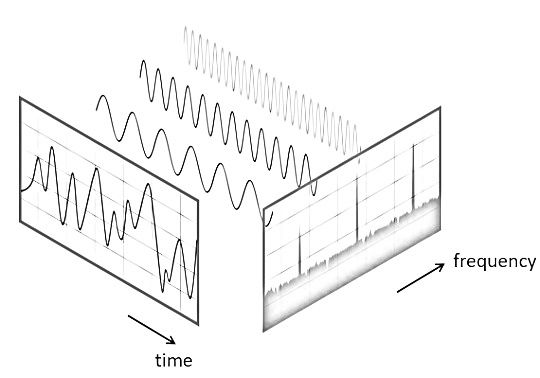
Every rotating machinery generates some sort of vibration due to various defects like unbalance in the impeller, eccentricity in the impeller, misalignment between motor and pump, structural looseness, bearing defect… etc. Every defect (above mentioned) generates vibration at a unique frequency. Generally, the measured vibration signal of real-world equipment is complex, and it is in the time domain. i.e., Amplitude Vs Time as shown in the following figure.
To diagnose the source of the defect the real-world vibration signal has to be transformed to the frequency domain using the Fourier transform. The maximum amplitude corresponding to a particular frequency reveals the source of the defect as shown in the following figure.
The process of transforming the real-world vibration signal from the time domain to the frequency domain and troubleshooting the source of the defect is called vibration analysis.

See less