Lost your password? Please enter your email address. You will receive a link and will create a new password via email.
Please briefly explain why you feel this question should be reported.
Please briefly explain why you feel this answer should be reported.
Please briefly explain why you feel this user should be reported.
Amechieneer is a platform where the questions can be answered, doubts can be cleared, knowledge can be self tested through relevant quizzes, interviews can be cracked easily by having a glance on previous interview experiences in Mechanical Engineering. Enjoy the learning.

What is the difference between Primary load and Secondary load?
Primary Load - Definition The load on the system due to gravitational force, spring force, internal or external fluid pressure, etc are called primary loads. The load on pipe support due to restricted thermal expansion of pipe comes under primary load. Characteristics i). The stresses generated dueRead more
Primary Load – Definition
The load on the system due to gravitational force, spring force, internal or external fluid pressure, etc are called primary loads. The load on pipe support due to restricted thermal expansion of pipe comes under primary load.
Characteristics
i). The stresses generated due to primary loads are non-self-limiting in nature. It means when the stress exceeds the yield point, the load will not dissipate. As long as the load is applied, the stress will present. The stress will not diminish with time or due to deformations. Hence they are called not self-limiting.
ii). The primary load is force driven type i.e. it is due to external force acting on the system.
iii). The failure due to primary load is relatively sudden, quick and catastrophic once the induced stress is greater than the failure stress.
iv) The loads should necessarily satisfy the simple laws of equilibrium.
Secondary Load
- The loads that cause self-limiting stresses are called secondary loads. · Eg. Loads due to temperature changes, settlement of foundations etc.
- The secondary loads are displacement driven.
- Secondary loads are not catastrophic in nature.
- Secondary stresses are strain-induced stresses.
- Secondary loads are self-limiting because the load disappears in the form of local yielding and distortion.
See lessWhat are the different levels of earthquakes?
Based on the probability of occurrence, the earthquakes are classified into two levels· They are a) S-1 Level b) S-2 Level S-1 Level Earthquake The maximum ground motion which is reasonably expected to occur once during the life of nuclear power plant with an estimated period of return of 100 years.Read more
Based on the probability of occurrence, the earthquakes are classified into two levels· They are
a) S-1 Level
b) S-2 Level
S-1 Level Earthquake
The maximum ground motion which is reasonably expected to occur once during the life of nuclear power plant with an estimated period of return of 100 years. In design S-1 level earthquake corresponds to OBE will resist S-1 level earthquake within the elastic limit.
S-2 Level Earthquake
The maximum ground. the ground motion which has a very low probability of occurrence with an estimated period of return of 10,000 years. In design, an S-2 level earthquake corresponds to SSE S-2 level earthquake can damage the components beyond their elastic limit. E.g. a Fuel pin in the nuclear reactor core can deform during an S-2 level earthquake but should not puncture.
See lessWhat is a safe shutdown earthquake (SSE)?
A safe shutdown earthquake is a level of ground motion where the features of the nuclear power plant are required for the safe shutdown of the reactor. The features are a) Those which assure the integrity of coolant pressure boundary. b) Those required for the safe removal of decay heat from the reaRead more
A safe shutdown earthquake is a level of ground motion where the features of the nuclear power plant are required for the safe shutdown of the reactor. The features are
a) Those which assure the integrity of coolant pressure boundary.
b) Those required for the safe removal of decay heat from the reactor.
c) Capability to shut down the reactor.
d) Confining the radioactive exposure to mitigate the offsite exposure.
The PGA of this level of earthquake should not be less than 0.1g. The probability of occurrence of this earthquake once in 10,000 years. In general safety-related components should withstand SSE.
See lessWhat is operating basis earthquake [OBE]?
Operating basis earthquake is a level of ground motion where the features of the nuclear power plant are required for continuing the operation. The component should function during OBE without undergoing any deformation. The level of ground motion of OBE is evaluated based on local geology, seismoloRead more
Operating basis earthquake is a level of ground motion where the features of the nuclear power plant are required for continuing the operation. The component should function during OBE without undergoing any deformation. The level of ground motion of OBE is evaluated based on local geology, seismology and subsurface characteristics. The nuclear power plant is under operation during OBE. If this level of earthquake is exceeded, the plant should be shut down and inspected for any damages had occurred. The plant should restart only after obtaining the “fit for operation” certificate. The peak ground acceleration of this type of earthquake should not be less than 0.05 g in the horizontal direction. The estimated return period is 100 years.
See lessWhether IGC practice – A test is alone sufficient to judge the susceptibility of the material to intergranular corrosion?
IGC practice - A test rapid screening test to test the susceptibility of austenitic stainless steel to IGA. Based on the test results of IGC practice - A, the material can be accepted or suspected but not rejected. Hence practice - A must be accompanied by some other tests to calculate the corrosionRead more
IGC practice – A test rapid screening test to test the susceptibility of austenitic stainless steel to IGA. Based on the test results of IGC practice – A, the material can be accepted or suspected but not rejected. Hence practice – A must be accompanied by some other tests to calculate the corrosion rate. By comparing the calculated corrosion rate and the allowable corrosion rate, the material can be accepted or rejected.
See lessWhen the IGC practice- C test is preferable?
The practice-C test is preferable when the intergranular corrosion is because of chromium depletion due to intergranular precipitation of chromium carbide and corrosion in intermetallic phases i.e sigma phase. The presence of high chromium content in stainless steel or any ferrite stabilizers acceleRead more
The practice-C test is preferable when the intergranular corrosion is because of chromium depletion due to intergranular precipitation of chromium carbide and corrosion in intermetallic phases i.e sigma phase. The presence of high chromium content in stainless steel or any ferrite stabilizers accelerates Delta-ferrite to Sigma phase transformation.
See lessWhat is IGC practice C test?
ASTM A262 standards have 5 different corrosion tests to test the susceptibility of Austenitic stainless steel to intergranular corrosion. IGC practice - C is one of those 5 tests. IGC practice- C involves the following steps: a. The austenitic stainless-steel sample is dipped in boiling, 65% NitricRead more
ASTM A262 standards have 5 different corrosion tests to test the susceptibility of Austenitic stainless steel to intergranular corrosion. IGC practice – C is one of those 5 tests.
IGC practice- C involves the following steps:
a. The austenitic stainless-steel sample is dipped in boiling, 65% Nitric acid for 48hrs duration.
b. After the first cycle, the sample is weighed to know the loss of weight due to corrosion. The loss is forecasted and expressed in terms of mills per year [Mpy].
c. The same cycle is repeated for the next 4 times. So in total, 240 hrs test duration in 5 different intervals. Each interval constitutes 48 hrs.
See lessd. The weight loss is calculated for all 5 cycles and an average value is found out.
e. The average value should be less than the allowable value to accept the material. In general the allowable corrosion rate followed industry is 18 Mills per year (Mpy)
What is intergranular corrosion?
When the austenitic stainless steel is heated in the range from 500 to 850 $^o C \, $ and allowed to cool slowly [i.e welding the austenitic stainless steel and allowing it to cool in the air], the carbon in the grains diffuses to the is grain boundary. Because the diffusivity of carbon is greater tRead more
When the austenitic stainless steel is heated in the range from 500 to 850
 and allowed to cool slowly [i.e welding the austenitic stainless steel and allowing it to cool in the air], the carbon in the grains diffuses to the is grain boundary. Because the diffusivity of carbon is greater than chromium at high temperatures. This is due to the size of carbon is half the size of chromium. Hence carbon diffuses faster. The carbon combines with chromium and forms chromium carbide. Thus, chromium is not available in the grain boundary to form an inert layer called chromium oxide. And also, the chromium layer carbide in the grain boundary acts as a narrow anodic zone and the grains rich in chromium act as a cathodic zone. It results in galvanic coupling and leads to the corrosion between grains i.e., in the grain boundary called inter-granular corrosion.
See lessWhat is Inch Meter Piping?
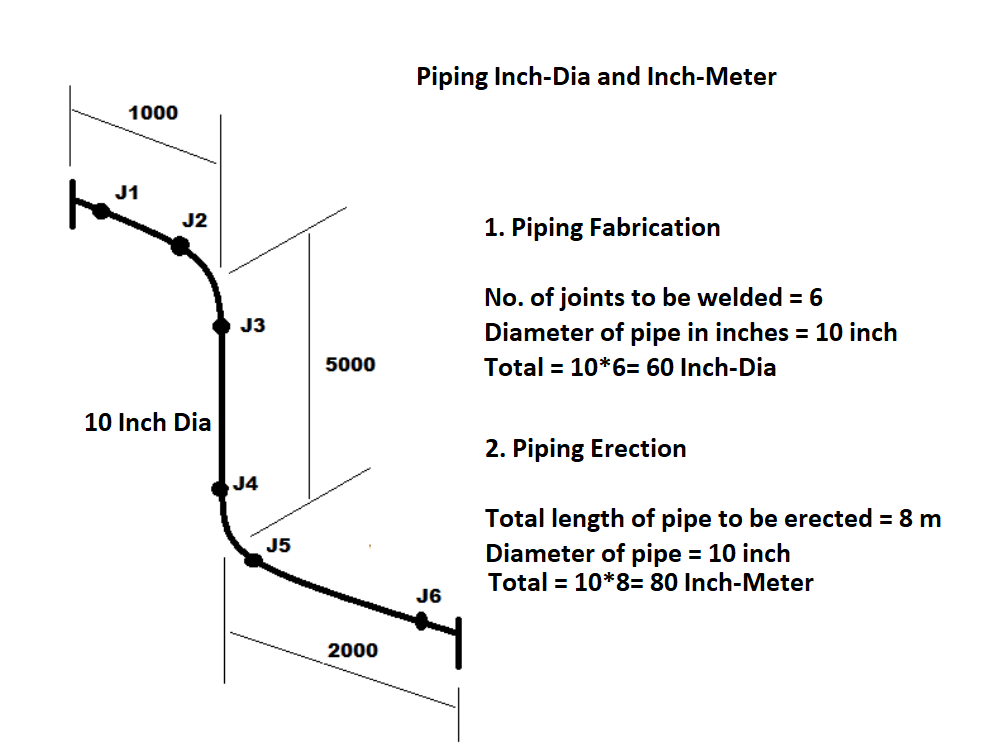
An inch meter is a measure of the quantum of piping erection in a construction project. The formula for Inch Meter is as follows. Formula: Pipe Diameter in Inch $ \times \, $ Length of pipe in meters. An inch Meter is used to express the quantum of hydro test in a piping system.
An inch meter is a measure of the quantum of piping erection in a construction project. The formula for Inch Meter is as follows.
Formula: Pipe Diameter in Inch
 Length of pipe in meters.
An inch Meter is used to express the quantum of hydro test in a piping system.

See lessWhat is meant by Inch-Dia in piping?
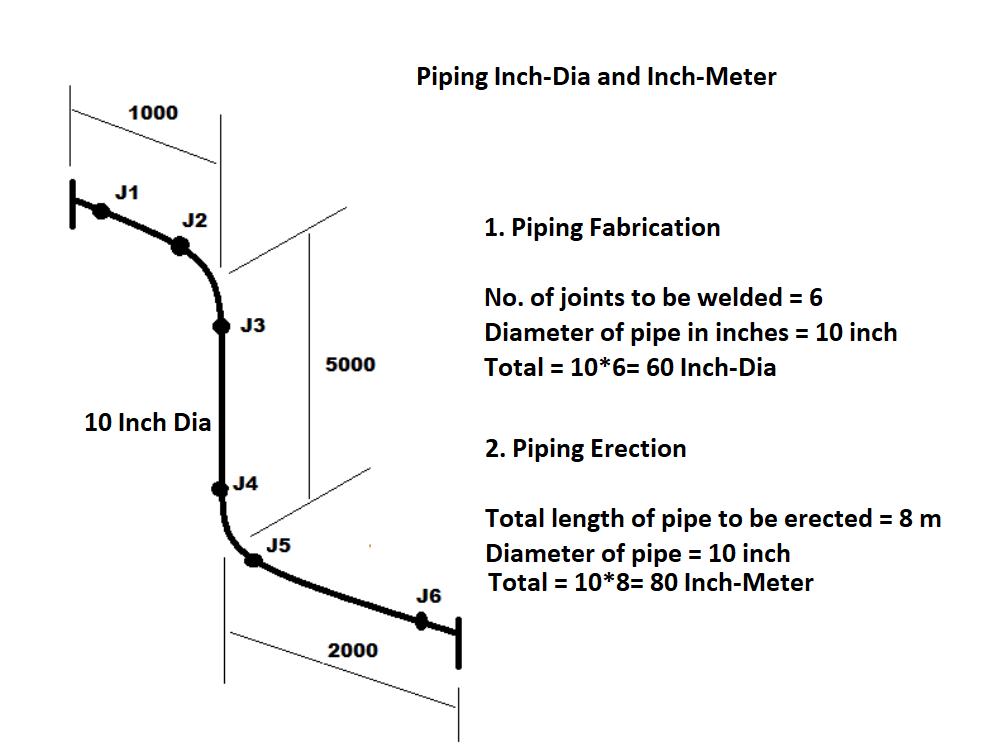
An Inch diameter is a measure of the quantum of welding works in joining the pipelines of a construction project. The formula for Inch-Diameter is as follows. Formula: Pipe Diameter in Inch $ \times \, $ Number of joints.
An Inch diameter is a measure of the quantum of welding works in joining the pipelines of a construction project. The formula for Inch-Diameter is as follows.
Formula: Pipe Diameter in Inch
 Number of joints.

See less